Digital borescopes enable efficient HVAC diagnosis by identifying evaporator core micro-leaks and oil loss without requiring exhaustive dashboard teardowns. This non-invasive technique relies on inserting micro-cameras through blower motor resistor ports or condensate drain tubes to gain visual confirmation of defects.
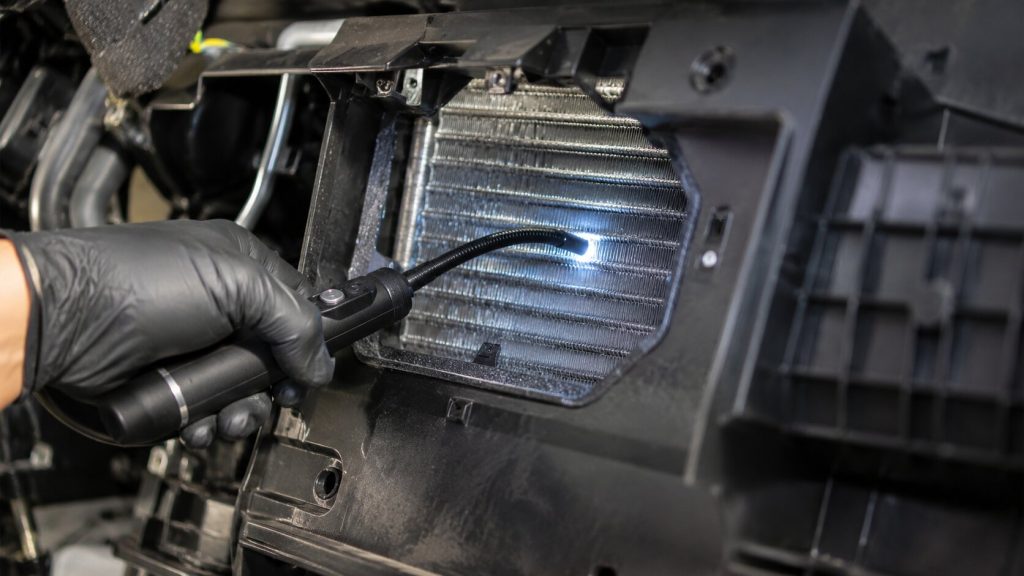
Modern dual-zone HVAC systems frequently develop micro-leaks in their aluminum microchannels, especially in humid climates like Meridian. Accurate diagnosis prevents the standard, costly full-dash teardown.
Understanding Evaporator Core Failure and Corrosion
Modern evaporator cores utilize thin-gauge aluminum microchannels for thermal efficiency, but these are highly susceptible to environmental corrosion. When moisture condensation mixes with road salts and acidic dust, it creates a corrosive film that degrades the metal structure. Over time, this galvanic degradation leads to localized pitting and microscopic fissures. As the AC system cycles through pressure changes, these weakened spots eventually fracture, allowing refrigerant gas and compressor oil to escape.
How Digital Borescopes Detect Evaporator Leaks
Locating pinhole leaks without dismantling an entire dashboard requires a systematic, non-invasive digital borescope protocol. High-definition micro-cameras are inserted through the HVAC blower motor resistor port or condensate drain tube to inspect the hidden face of the evaporator core.
- Nitrogen Pressurization: Pressurizing the air conditioning system with a dry nitrogen test charge of up to 150 PSI forces tracer gas and oil residue through hidden crevices without compromising weakened seals.
- Borescope Insertion: Feeding the articulating digital borescope directly into the housing cavity maps internal chambers instantly.
- Ultraviolet Scanning: Switching the borescope lens to ultraviolet mode and flooding the core interior with UV light makes pitted aluminum surfaces and oily witness marks glow brilliantly against the dark plastic housing.
- Defect Mapping: Digital grid overlays help pinpoint whether the failure lies within a core tube or at the expansion valve O-ring.
Avoiding Expensive Dashboard Teardowns
Last Tuesday, a 2022 SUV arrived with a suspected evaporator leak. Using the borescope, I caught a hair-line corrosion crack on the lower header tank, not the core face, saving the customer 14 hours of dash-removal labor.
By inserting digital borescopes through the blower resistor or cabin air filter housing, I can directly visualize the evaporator core. This allows for precise identification of failure modes, such as localized pitting or joint leaks, without discharging coolant lines or disturbing the dashboard. Visual confirmation eliminates guesswork, ensuring only necessary components are replaced and preserving the vehicle’s factory integrity.
Diagnostic Verdict: If the borescope reveals lime-white crusting on the lower header tank adjacent to the expansion valve, it’s a galvanic corrosion site driven by local winter salt residue, not a factory defect. This rules out warranty replacement claims and points straight to localized environmental degradation.
Refrigerant Recovery and Environmental Safety
Environmental regulations mandate the use of certified recovery equipment for R134a and R1234yf refrigerants before testing or repairs. Avoiding temporary fixes, such as stop-leak additives and repeated top-offs, is critical, as these contaminate equipment and damage compressors. Professional diagnosis precisely identifies refrigerant loss and oil degradation, allowing for accurate system flushing and oil replenishment. Adhering to these protocols ensures environmental compliance while preventing compressor failure.
Complete AC System Pressure Testing Protocols
Verifying a successful repair requires a rigorous vacuum pull to ensure the system is completely sealed and dry. I use specialized pumps to reach a deep vacuum of 500 microns, a level of low pressure that causes any remaining liquid moisture to boil off and exit the system. By holding this vacuum for thirty minutes, I confirm that every new O-ring and joint is perfectly airtight before recharging the system.
- Micron Level Evacuation: Pulling deep vacuums removes trapped atmospheric humidity that causes acid formation and premature compressor burnout.
- Electronic Sniff Testing: Complementing optical borescope scans with heated diode refrigerant sniffers confirms zero secondary leakage paths across firewall grommets.
- System Charge Calibration: Weighing exact refrigerant charges by factory weight specifications prevents liquid slugging and ensures optimal evaporator core superheat calculations.
Executing these strict validation steps eliminates callbacks and guarantees long term climate control reliability under punishing summer operating conditions. Meridian drivers rely on precise refrigerant mass measurements to sustain maximum cooling output during peak seasonal heat waves.
Get a Precision Evaporator Audit Today
A targeted digital borescope inspection identifies microchannel fissures optically, saving you dozens of labor hours and protecting your vehicle’s factory integrity.
Skip the blind 14-hour dashboard teardown and bring your vehicle to John’s Auto Care Center at 499 S Meridian Rd, Meridian, ID 83642 for a direct borescope core audit before your compressor drops metal into the lines.
Frequently Asked Questions
Can a micro leak in an evaporator core be repaired with stop leak additives?
No. Stop-leak additives rarely fix evaporator micro leaks permanently and often clog expansion valves, heater cores, and expensive recovery machines. The only reliable fix for a compromised core is replacement or precision welding if accessible.
How long does a digital borescope HVAC inspection take?
A professional borescope inspection of an evaporator core typically takes less than one hour because I access the housing through existing blower motor ports or drain tubes. This method saves hours of labor compared to traditional dashboard teardowns.
Will my car pass local emissions testing with a leaking evaporator?
Yes. Minor refrigerant leaks escaping from an evaporator core leave tailpipe emissions and engine management computers completely unaffected during standard testing. However, the loss of functional cooling severely impacts vehicle usability during peak summer heat waves.
Does insurance cover the replacement of a corroded evaporator core?
No. Standard auto insurance policies treat evaporator core corrosion as normal mechanical wear and tear rather than a sudden collision-related loss. Comprehensive warranties also rarely cover environmental corrosion unless specific extended protection packages apply.