


August gridlock on Eagle Road causes severe automotive air conditioning stress, spiking refrigerant pressures and destroying compressor components. Shop diagnostics reveal how micro-channel condenser failures, cooling fan degradation, and electrical resistance create dangerous thermal overloads. Protect vehicles by scheduling professional pressure testing and system maintenance in Meridian before summer heat causes total mechanical failure.
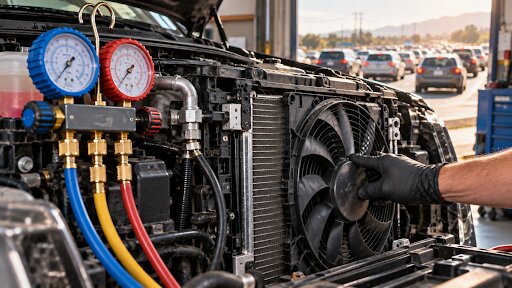
August idling on Eagle Road bakes vehicle air conditioning systems when bumper-to-bumper commuter traffic starves the condenser of forward airflow. That intense heat destroys compressor clutches on commuter cars stuck in traffic on hot afternoons.
Traffic-Induced Thermal Overload and Cabin Symptoms
The initial warning sign of thermal overload is your AC blowing ambient air the moment you drop below cruising speed in heavy traffic. Stopping and starting in traffic traps heavy heat under the hood, ruining fragile AC components like the compressor valve and condenser.
When driving at highway speeds, incoming air naturally flows through the condenser coils to release heat pulled from the cabin. Heavy traffic halts this airflow completely, preventing the refrigerant gas from cooling and turning back into liquid. As a result, system pressures spike past safe limits, causing the compressor clutch to cycle rapidly. The intense heat ruins the internal oil, destroying metal bearings and valves until the compressor breaks down completely.
Diagnostic Process for Car Air Conditioning
Inspecting a failing air conditioning system before compressor shrapnel fills the accumulator requires isolation testing with high-end diagnostic equipment rather than a simple refrigerant top-off.
- Hooking Up Gauges: Connect digital gauges to check high and low pressure while running the AC on maximum.
- The Water Test: Spray the condenser face with water to simulate highway airflow and observe how fast head pressures drop. If the pressure won’t drop below 225 psi with the water test, the cooling fan motor is weak and not spinning hard enough.
- Relay Testing: Test the voltage drop at the fan relay to verify the car’s computer is actually getting the right outside temperature data.
Diagnostic Verdict: When I hook up gauges on an Eagle Road commuter vehicle baking in August gridlock, and the high-side pressure refuses to drop past 225 psi during a condenser water test, I immediately flag a failing fan motor or a packed micro-channel core, never a simple low-charge issue.
Terminal Mechanical Failure and Internal Contamination
When a compressor moves past thermal overload into mechanical destruction, it gives off unmistakable failure signs. A worn-out clutch bearing will create a loud squealing or grinding noise the moment you turn on the air conditioning.
Once the swashplate strips, microscopic gray aluminum silt floods the drier core, permanently contaminating the entire loop. Inspecting the filter elements and drier during routine service helps catch this metallic debris early. Ignoring these red flags results in total system contamination, which forces the replacement of the condenser, accumulator, expansion valve, and compressor all at once.
Condenser Efficiency Recovery and Chemical Flushing
Restoring cooling performance on commuter vehicles requires specialized chemical cleanings and fin repairs that standard oil change shops often miss. When road debris and bugs pack tightly against the aluminum condenser tubes, heat release drops by nearly 40%. Using a low-pressure foaming cleaner built specifically for micro-channel aluminum lifts oxidation without bending fragile cooling fins.
- Straightening Fins: Straightening bent cooling fins lets fresh air flow smoothly across the core again.
- Chemical Cleaning: Using special foaming cleaners washes away tough road dirt without damaging the aluminum.
- Checking Temperature Drops: Measuring precise subcooling temperature changes confirms that the expansion valve is metering refrigerant correctly in extreme heat.
Electrical Load and Voltage Drop During Idle
Running the AC fans, blowers, and defrosters all at once pulls a ton of power, especially when you are stuck idling in traffic. When temperatures top 100 degrees, wiring resistance goes up, forcing the alternator to work much harder. If the system voltage dips below 13.2 volts, the AC compressor clutch starts to slip. That friction creates intense heat that melts the internal wiring.
- Heavy Electrical Load: Running multiple fans and blowers strains older alternators in stop-and-go traffic.
- Low Voltage Warning: Voltage drops below 13.2 volts cause the AC clutch to slip and overheat.
- Wiring Checks: Testing the power harness prevents unexpected electrical issues from knocking out your AC.
Beat the Heat Before Your AC Fails
Delaying diagnostics until the vents blow ambient air transforms a straightforward fan relay replacement into a total system decontamination. Dealership generic multi-point inspections miss thermal overloads; isolating root-cause voltage drops requires real-time manifold gauge and lab scope analysis. Stop by John’s Auto Care Center at 499 S Meridian Rd, Meridian, ID 83642 to test your AC pressures before a breakdown leaves you stranded in traffic.
Frequently Asked Questions
Can idling in traffic really destroy a car air conditioning system?
Yes. Prolonged idling during extreme summer heat eliminates the natural airflow needed to cool the condenser coils. That lack of airflow causes refrigerant pressures to spike dangerously high, which overheats and damages internal compressor components.
Does turning the air conditioning off prevent compressor damage during a heatwave?
No. Turning the system off entirely only saves fuel and cabin comfort, but it does not fix an underlying airflow or pressure issue. Proper diagnosis requires checking cooling fan operation and refrigerant charge levels before component failure occurs.
Will a simple refrigerant recharge fix warm air during gridlock?
No. Adding refrigerant to a system suffering from thermal overload usually worsens high-side pressure spikes. Technicians must first test system pressures and cooling fan performance rather than assuming the refrigerant simply leaked out.
How often should commuter vehicles have their air conditioning inspected?
Annual pre-summer inspections catch weak cooling fans and restricted condensers before August temperatures arrive. Catching these issues early prevents expensive compressor replacements down the road.
