Controller Area Network communication errors disrupt vehicle cabin cooling by blocking body control module commands. This guide details signal degradation physics, oscilloscope diagnostics, and module isolation techniques. Meridian drivers learn how professional troubleshooting restores air conditioning without costly harness replacements or long dealership backlogs.
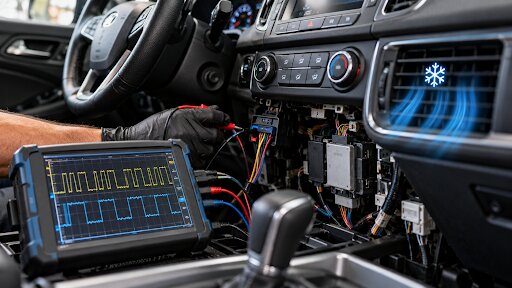
Meridian Speedway dust mixes with high desert heat to bake vehicle wiring harnesses until data packets stop flowing and the cabin turns into an oven. When a multiplexed network drops its voltage differential, the body control module fails to broadcast the air conditioning request command to the powertrain control module. Meridian drivers lose cabin cooling on hot afternoons when data packets collide across the network lines.
Primary Diagnostic Parameters for Network Failures
- Primary Symptom: Intermittent cabin blower operation and unresponsive climate control display buttons.
- Target Component: Controller Area Network high and low twisted pair data lines and node modules.
- Specialized Tooling: Digital storage oscilloscope and breakout box for serial data monitoring.
- Local Environmental Stressor: Extreme temperature swings near Meridian Speedway and fine track dust intrusion.
- High Risk Profile: High mileage vehicles operating in heavy dust environments with aftermarket accessories.
Diagnosing Multiplexed Wiring and Voltage Drop on the CAN Bus
Modern vehicle climate systems rely on serial data communication rather than direct analog switches. The controller area network uses a dual wire bus designated as high and low to transmit differential voltage signals between distributed electronic control units. Under normal operating conditions these lines maintain a recessive state of 2.5 volts and shift to 3.5 volts for dominant states.
Thermal cycling and persistent vibration near the dashboard and firewall stress these delicate copper pathways. Microscopic chafing creates high resistance points or allows moisture and dust to bridge the twisted pair circuit. When resistance spikes or short circuits develop, signal degradation corrupts the digital frames.
Voltage drop across damaged harness connectors prevents the body control module from transmitting the digital packet commanding the compressor clutch to engage. Receiver modules log communication faults while the physical hardware remains undamaged.
How Modern Vehicle Network Architectures Operate
Vehicle electronics depend entirely on shared digital highways to coordinate complex mechanical tasks without miles of heavy copper wiring. Understanding how these pathways distribute data helps me isolate communication faults efficiently.
Multiplexed Messaging Protocols in Modern Vehicles
Every module on the network shares a common communication channel using standardized voltage pulses to transmit binary messages. Modules drop offline into a protective bus off state whenever network data packets fail to transmit.
Power Distribution and Ground Integrity
Subtle voltage variations across shared ground circuits disrupt the reference voltages required by sensitive microprocessors. Corrosion inside the firewall passes through connectors increases circuit resistance and distorts the clean square wave signals necessary for error free data delivery.
Step-by-Step Bus Network Troubleshooting and Module Isolation
Pinpointing a network communication error requires systematic isolation rather than simple part replacement. I always bypass standard generic code readers to examine raw packet traffic and physical layer integrity.
- First, I connect a digital storage oscilloscope to the data link connector using a dedicated breakout box. I verify that the combined network resistance measures precisely 60 ohms with the battery disconnected to prove the dual terminating resistors are intact.
- Second, I observe the square wave pattern on the oscilloscope display during key on engine off conditions. A biased waveform or flattened signal indicates a shortened module pulling the bus down.
- Third, I disconnect control modules one by one from the harness while watching the oscilloscope screen for waveform recovery. When the signal snaps back to clean digital pulses, I identify the last disconnected module as the internal fault source corrupting the network traffic.
Advanced Resistance Testing and Signal Verification
Validating the physical layer requires precise multimeter checks and specialized resistance testing across every node in the network.
Terminating Resistor Resistance Verification
Twin 120 ohm resistors located at opposite ends of the main network trunk establish the proper impedance load. Measuring total resistance across the data lines with the power completely removed must yield exactly 60 ohms to confirm the circuit remains balanced.
Isolating Shorted Control Modules on the Data Bus
When resistance readings deviate from factory specifications, I isolate individual modules from the harness sequentially. Monitoring resistance changes during each disconnection reveals exactly which internal node has failed and is dragging down the communication voltage.
Understanding Climate Control Module Integration
The climate control head unit does not operate in isolation. It relies on seamless data transmission to command auxiliary blower motors and blend doors.
Body Control Module Arbitration
The body control module acts as a central gateway translating driver switch inputs into broadcast network commands. If corrupted data packets block this specific transmission, the compressor relay remains permanently deactivated despite functioning hardware.
Powertrain Computer Response Failures
Once the climate request broadcast reaches the engine computer, software parameters evaluate engine load and coolant pressure. Network communication latency prevents the engine computer from acknowledging the request, leaving the compressor clutch unpowered.
Professional Climate System Restoration and Repair
Ignoring intermittent data communication faults leads to total electronic module failure and expensive cascading electrical repairs. Chasing ghost codes with a parts-cannon approach usually leads to unnecessary harness swaps, whereas scoping the physical layer exposes the actual micro-chafing point. I isolate the corrupted node by dropping modules off the bus one by one until the waveform snaps back to a clean 2.0-volt bias.
If your climate display locks up under high desert heat, bring it to John’s Auto Care Center at 499 S Meridian Rd, Meridian, ID 83642 to check your CAN high and low data integrity on the scope.
Frequently Asked Questions
Can a bad battery can use CAN bus communication errors affecting the AC system?
Yes. Low system voltage causes microprocessors to reset and corrupts digital data transmission packets across the network.
Is a diagnostic trouble code always stored when the climate control stops working?
No. Intermittent packet drops often fail to set a permanent fault code in standard memory registers.
Do aftermarket radio installations interfere with network climate commands?
Yes. Incorrect wiring integration on the entertainment bus frequently disrupts data traffic destined for the body control module.
Can localized dust and heat permanently damage vehicle wiring harnesses?
Yes. Thermal expansion combined with abrasive dust breaches connector seals and causes high resistance connection failures.