


AC desiccant bag replacement protects one of the most expensive parts of the system, the condenser. Spent desiccant stops absorbing moisture, and trapped water can form acids that corrode the condenser’s delicate internal passages from the inside. Replacing the desiccant on time prevents that slow, costly damage.
Why a Small Part Guards an Expensive One
Inside a modern air conditioning system sits a small, inexpensive material whose entire job is to protect far costlier components. The desiccant, held in an element or cartridge that is often built into the condenser itself on current designs, absorbs the moisture that would otherwise cause trouble. It is cheap, it is replaceable, and it is easy to forget.Once that happens, it stops doing the one job it was installed to do, and the moisture it used to
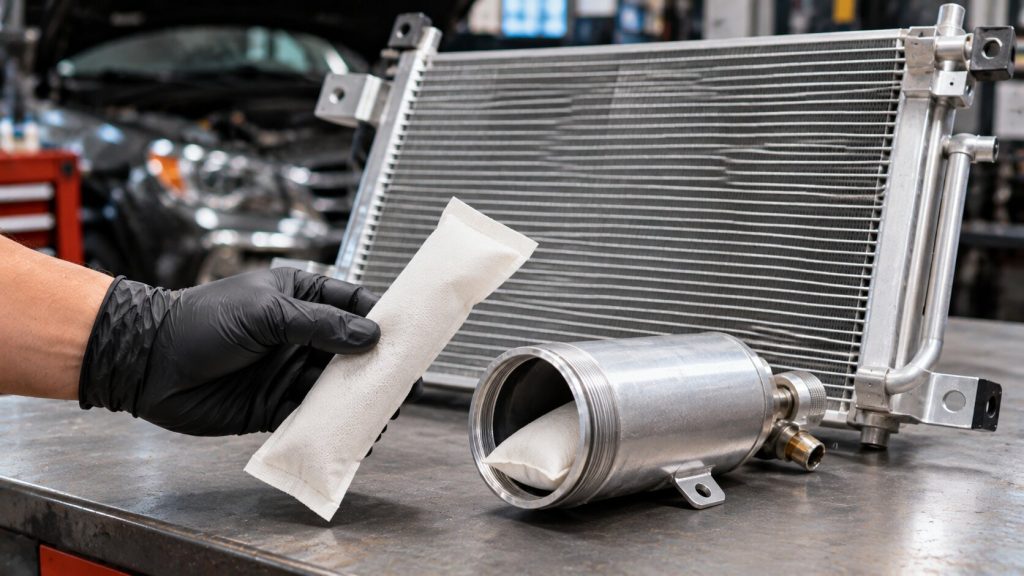
The component it protects is anything but cheap. The condenser is a large, intricately built part at the front of the system, and replacing one is a significant repair. So the economics are lopsided in the owner’s favor, a minor maintenance item standing guard over a major one.
That imbalance is the whole argument for staying on top of desiccant replacement. Spending a little to keep the desiccant fresh is spending to avoid the much larger cost of a condenser that has been damaged from the inside.
What Happens When Desiccant Becomes Saturated
Desiccant works by absorbing moisture, but it has a limit. Like a sponge that can only hold so much water, it eventually reaches a point where it is fully saturated and can absorb no more. capture is now free in the system.
This is the quiet turning point most owners never see. There is no warning light for a saturated desiccant, and the AC may still cool reasonably well for a while. The protection has simply stopped, and moisture has begun to accumulate where it does not belong, inside a system designed to stay dry.
The distinction worth drawing is between a desiccant that is working and one that is merely present. A saturated element is still physically there, but it is no longer protecting anything. From that moment, the clock on internal damage starts running.
How Trapped Moisture Turns Into Internal Corrosion
This is where a maintenance oversight becomes a mechanical problem. When moisture is left circulating in the system, it does not stay inert. Combined with the refrigerant and the oil, water can lead to the formation of acids inside the system, and those acids are what make the situation genuinely damaging.
The condenser is especially vulnerable because of how it is built. Its internal passages are made of thin, delicate aluminum, designed to transfer heat efficiently rather than to resist corrosion. Over time, the acids that form from trapped moisture can corrode those fine passages from the inside, where no inspection can easily see it.
That inside-out pattern is what makes this failure so costly. The damage is done quietly, internally, and by the time it shows itself as poor cooling or a refrigerant leak, the corrosion inside the condenser may already be advanced. The part that fails was attacked from within, long before anyone could tell.
Why This Is Purely a Cost-Savings Issue
Strip away the chemistry and this comes down to simple economics. The desiccant is among the least expensive elements in the AC system. The condenser is among the most expensive. Allowing the first to lapse in order to save a small maintenance cost risks the failure of the second, which is a poor trade by any measure.
Replacing the desiccant on a sensible schedule, or whenever the system is already open for other work, keeps the protection active and the condenser safe. It is one of those maintenance items where the cost of doing it is trivial next to the cost of not doing it. The savings are real precisely because the alternative is so expensive. Our air conditioning service and repair work treats the desiccant as part of protecting the system’s costly components, not as an optional extra.
There is also a timing advantage. Because the desiccant is frequently integrated with or located near the condenser, it is most economical to address during other AC service, when the system is already accessible. Handling it then avoids both the damage and a separate labor charge later.
What an Owner Can Keep in Mind
A driver cannot measure desiccant saturation from behind the wheel, but a few habits help. Knowing roughly how old your system is, and whether the desiccant or condenser has ever been serviced, gives you a sense of whether this protection is likely still doing its job or quietly spent.
If your AC system is opened for any repair, it is reasonable to ask whether the desiccant should be refreshed while access is easy. On an older vehicle that has never had this attention, raising it with us is worthwhile, not because failure is certain, but because prevention here is so much cheaper than the cure.
If your cooling has started to weaken, or the system has been serviced before without the desiccant being addressed, it is worth a look. Catching a saturated element early protects the condenser before the acids have time to do their work.
Schedule an Appointment to Protect Your Condenser
If your AC is due for service or has never had its desiccant refreshed, an early check is a simple way to protect one of the system’s most expensive components. Keeping the desiccant fresh keeps moisture out and the condenser safe, which keeps your long-term costs down.
We are glad to inspect the system and tell you honestly whether the desiccant needs attention. Schedule an appointment with John’s Auto Care Center at (208) 974-5216, or stop by 499 S Meridian Rd, Meridian, ID 83642.
Frequently Asked Questions
Can a saturated desiccant really damage my condenser?
Yes. Once it stops absorbing moisture, trapped water can form acids that corrode the condenser’s thin internal passages over time, leading to costly failure.
How do I know if my desiccant needs replacing?
You often cannot tell from the driver’s seat, which is why system age and service history matter. A check during other AC work is the reliable way to know.
Is replacing the desiccant expensive?
The desiccant itself is inexpensive, especially when done during other AC service. It is far cheaper than the condenser repair it helps prevent.
Why does moisture form acids inside an AC system?
When water mixes with the refrigerant and oil, the resulting chemical reaction can produce acids, and those acids are what corrode internal metal surfaces.
Should the desiccant be replaced during other AC repairs?
Usually yes. Because it is often integrated near the condenser, servicing it while the system is already open is the most economical time to do it.
