


Remanufactured vs OEM AC compressor is a genuine budget decision for high-mileage truck and SUV owners. A remanufactured unit costs less upfront, while a new OEM compressor offers maximum predictability. The right choice depends on the vehicle’s age, how hard it works, and how long you plan to keep it.
Why This Decision Comes Up on Higher Mileage Vehicles
A compressor replacement is one of the larger AC repairs an owner faces, so when it is needed on a truck or SUV with real miles on it, the question of which compressor to fit becomes a real financial choice rather than an automatic one. On a newer vehicle the answer is usually straightforward. On an older, harder-working one, it deserves some thought.
The reason is that the math changes with the vehicle. The money that makes clear sense on a car you will keep for another decade looks different on one you might move on from in a couple of years. Matching the part to the plan is what keeps the decision smart rather than simply expensive or simply cheap.
This is especially true for vehicles that tow. Towing asks more of a compressor than ordinary driving, and that added demand is part of what should shape the choice between a remanufactured unit and a new OEM one.
What Each Option Actually Means
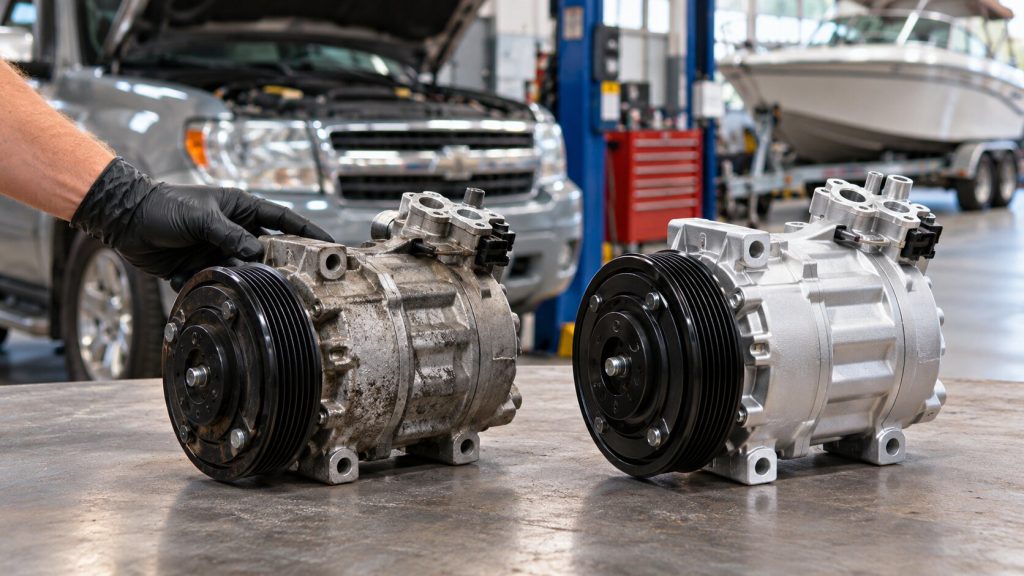
The two terms describe genuinely different parts, and understanding the difference is the foundation of the decision. An OEM compressor is a brand-new component, built to the vehicle manufacturer’s specification, with no prior service history. It is the same part the vehicle would have received when it was new.
A remanufactured compressor is a used unit that has been taken apart, cleaned, inspected, and rebuilt with worn internal parts replaced, then tested to a working standard. It is not simply a used part pulled from another vehicle. It has been restored, which is what separates a quality remanufactured unit from a salvage-yard gamble.
The distinction that matters to an owner is this. OEM offers the predictability of something entirely new, while a quality remanufactured unit offers much of that reliability at a lower cost, provided it comes from a reputable rebuilder. Neither is simply better. They sit at different points on the price-and-certainty scale.
Weighing Cost Against Long-Term Reliability
The clearest advantage of a remanufactured compressor is the lower upfront cost, and for many high-mileage owners that saving is meaningful. It can be the difference between fixing the AC now and putting it off, and a well-remanufactured unit from a trusted source can serve reliably for a long time.
The case for new OEM is predictability over the long run. A new part has no prior wear anywhere inside it, which generally translates to the longest and most consistent service life. For an owner planning to keep a vehicle for many more years, that longevity can justify the higher price, because the goal is to not revisit this repair again.
The honest framing is that there is no single right answer, only the right answer for your situation. The quality of the specific part and the reputation of its source often matter as much as the category label, which is why the conversation is worth having rather than defaulting to whichever is cheaper or whichever is newest.
Why Towing Changes the Calculation
Towing is where this decision earns extra attention. Pulling a trailer or hauling heavy loads keeps the engine and the AC system working harder and hotter for longer, and the compressor feels that sustained demand directly. A part that would be perfectly adequate for light commuting is being asked to do considerably more.
Under that kind of repeated heavy load, the long-term durability of the compressor becomes more valuable, because the cost of a second failure is not just the part but the downtime and the repeat labor. For a vehicle that tows regularly, leaning toward the more durable option can be the more economical choice over time, even at a higher initial price.
That said, a quality remanufactured unit built to handle the vehicle’s specification can still be a sound choice for a towing vehicle. The point is not that towing rules out one option, but that it raises the weight you should give to durability when you decide. Our AC compressor service and replacement work includes helping owners weigh exactly that trade-off for how their vehicle is actually used.
What to Ask Before You Decide
An owner does not need to be a technician to make a good call here, just to ask the right questions. It helps to know the source and reputation of a remanufactured unit, what its warranty covers, and how that compares to the OEM option for the specific vehicle. A part is only as good as the standard it was built and tested to.
It is also worth being honest with yourself about the vehicle’s future. How long you intend to keep it, how hard it works, and whether it tows all feed into whether the upfront saving or the long-term predictability is the better value for you. Those answers point toward the right part more reliably than price alone.
If a compressor replacement is on the horizon, it is worth a conversation before committing. Talking through how you use the vehicle lets us match the recommendation to your plans and your budget rather than to a default.
Schedule an Appointment to Talk Through Your Options
If your truck or SUV needs a compressor and you are weighing remanufactured against OEM, we are glad to walk through the trade-offs for your specific vehicle and how you drive it. The goal is a choice that fits both your budget and how long you plan to keep the vehicle on the road.
Schedule an appointment with John’s Auto Care Center at (208) 974-5216, or stop by 499 S Meridian Rd, Meridian, ID 83642.
Frequently Asked Questions
Is a remanufactured compressor reliable enough for a high-mileage vehicle?
Yes, when it comes from a reputable rebuilder and is built to the vehicle’s specification. Quality and source matter as much as the category itself.
Does an OEM compressor last longer than a remanufactured one?
Generally a new OEM part offers the most predictable long-term life, though a well-remanufactured unit from a trusted source can also serve reliably.
Is remanufactured always the cheaper choice overall?
Not always. It costs less upfront, but if long-term durability matters for how you use the vehicle, the more durable option can be more economical over time.
Does towing mean I should choose OEM?
Not necessarily. Towing raises the value of durability, so it is worth weighing, but a quality remanufactured unit built to spec can still suit a towing vehicle.
Should warranty coverage affect my decision?
Yes. Comparing what each option’s warranty covers is a sensible part of the choice, since it reflects the confidence behind the part.
