


AC system flush cost sits far above a simple part replacement, and the gap is the whole reason early maintenance pays off. When an aging receiver-drier is replaced on time, the system stays clean and the repair stays small. When it fails and contaminates the system, a full flush becomes the far costlier fix.
Why One AC Repair Can Cost So Much More Than Another
Two cars can arrive with what sounds like the same AC complaint and leave with very different bills. The difference usually is not the labor rate or the parts markup. It is whether the problem stayed contained to one component or spread through the whole system before anyone addressed it.
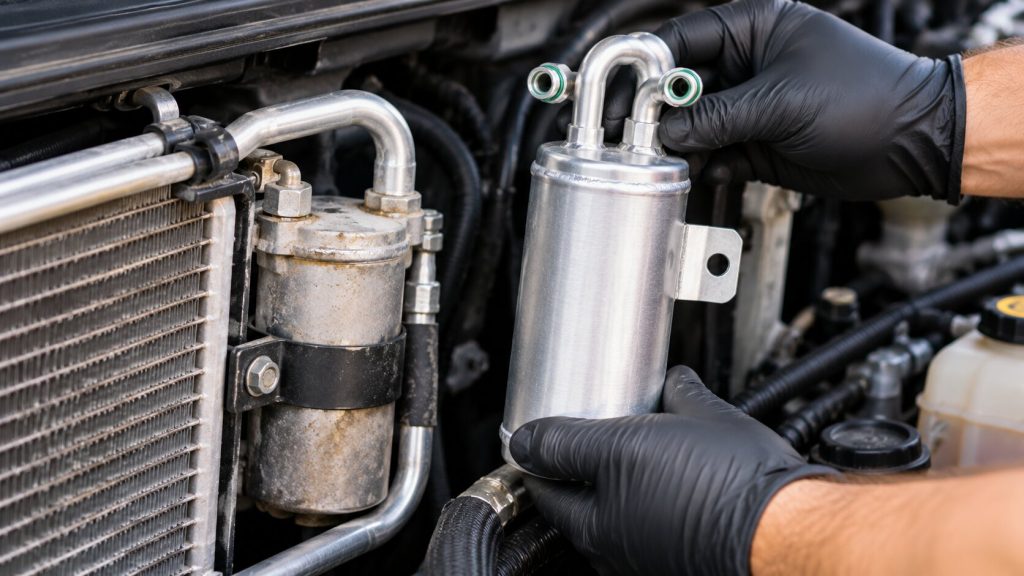
A contained problem is a parts-and-labor job. You replace the failed component, recharge the system, and the car is back in service. A spread problem is a different animal, because now the system itself is contaminated, and cleaning it adds a major step that a simple replacement never required.
That spreading is what drives the cost gap. The part that fails is rarely the expensive part. The expensive part is everything the failure touches on its way out, and the cleanup that touching demands.
What the Receiver-Drier Actually Does
The receiver-drier is a small part that rarely gets much attention, yet it does something the whole system relies on. Inside it sits a material called desiccant, and its role is to soak up the small amounts of moisture that find their way into the refrigerant over time. That matters because a dry system resists internal corrosion, and it lets the refrigerant flow and cool the way it should.
Like any filter-type component, it has a working life. The desiccant can only absorb so much moisture before it is saturated, and once it is full, it no longer protects the system the way it should. This is why the receiver-drier is treated as a maintenance item, something meant to be replaced on a sensible schedule rather than run until it fails.
Here is the distinction that matters for cost. A receiver-drier replaced on time is a routine part swap. A receiver-drier left in place until it degrades can become the source of a system-wide problem, and that is where a simple job turns expensive.
How a Failed Drier Contaminates the Whole System
When a receiver-drier is pushed well past its service life, the risk is not just that it stops absorbing moisture. In the worst cases, the desiccant material inside can break down and escape into the refrigerant loop, and that is the event that changes everything about the repair.
Once loose desiccant and debris circulate through the system, they do not stay in one place. They travel through the lines and can reach the components the system depends on, including the expensive ones. At that point the contamination is no longer a single-part issue, it is throughout the loop, and it cannot simply be charged over.
This is exactly when a flush becomes necessary. To clean out that circulating contamination, the system has to be flushed thoroughly so the debris does not damage what comes next. The flush is not an upsell, it is the only way to make the system safe to run again, and it is the cost a timely part replacement was meant to prevent.
Why Early Replacement Is the Cheaper Path
The economics here are unusually clear. Replacing an aging receiver-drier before it degrades keeps the desiccant intact and contained, which keeps the entire problem to the cost of one modest part and the labor to fit it. Nothing spreads, so nothing extra needs cleaning.
Waiting until it fails inverts that math. Now the bill can include the flush, the refrigerant, and potentially other components that the contamination reached, which together dwarf the cost of the part that started it all. The same component, handled at two different times, produces two very different invoices. The way we look at it, replacing the receiver-drier during other AC work is often the smartest preventative money an owner can spend.
The receiver-drier is also commonly replaced whenever the system is already open for another repair, precisely because it is inexpensive to do then and costly to ignore. Folding it into existing work is the cheapest moment to handle it. Our air conditioning service and repair approach treats that timing as part of protecting the whole system, not just fixing the immediate complaint.
What an Owner Can Keep in Mind
A driver cannot see a saturated desiccant or inspect a receiver-drier from the seat, but a few things are worth keeping in mind. If your AC system has been opened for a repair, it is reasonable to ask whether the receiver-drier should be replaced at the same time, since that is the economical moment to do it.
It also helps to know the age and history of your system. A receiver-drier that has never been replaced on an older vehicle is worth raising with us, not because it is guaranteed to fail, but because catching it before it degrades is what keeps a small cost from becoming a large one.
If your cooling has weakened or the system has been opened before without the drier being addressed, it is worth a conversation. Handling it early is far cheaper than cleaning up after it, and it keeps the system reliable without the surprise of a flush.
Schedule an Appointment to Protect Your System
If your AC is due for service or your receiver-drier has never been replaced, an early check is a straightforward way to keep a small maintenance item from turning into a major repair. Handling it on time keeps the system clean and the cost predictable.
We are glad to inspect the system and tell you honestly where the receiver-drier stands. Schedule an appointment with John’s Auto Care Center at (208) 974-5216, or stop by 499 S Meridian Rd, Meridian, ID 83642.
Frequently Asked Questions
Is an AC flush really that much more expensive than replacing a part?
Often yes. A flush adds significant labor and cleanup on top of parts, which is why preventing contamination usually costs far less than cleaning up after it.
Does the receiver-drier need replacing even if my AC still cools fine?
It can. It is a maintenance item that wears out gradually, so replacing it on schedule protects the system before performance visibly drops.
Why would one bad part require flushing the entire system?
Because degraded desiccant and debris can circulate through the whole loop, and a flush is the only way to remove that contamination safely.
Should the receiver-drier be replaced during other AC repairs?
Usually yes. When the system is already open, it is inexpensive to replace then, which is far cheaper than doing it as a separate job later.
Can I avoid a flush once contamination has spread?
Generally no. Once debris is circulating through the system, flushing is typically required to protect the remaining components from damage.
