


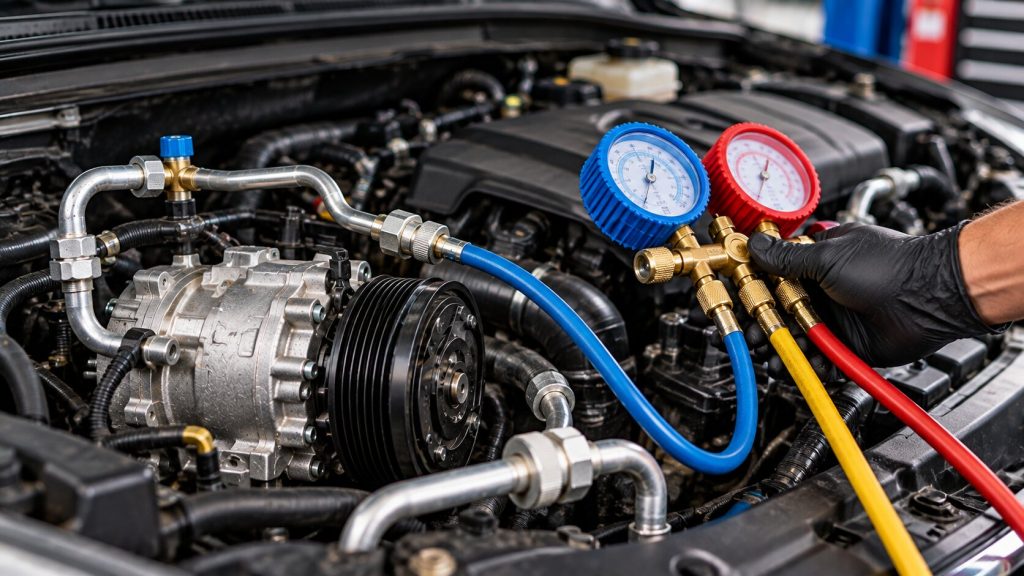
Car AC fuel economy cost rises when service is delayed, because a low or struggling system makes the compressor work inefficiently. A compressor forced to short-cycle draws extra engine power for less cooling, and that wasted effort shows up as reduced fuel efficiency, especially in slow, stop-and-go commuter traffic.
Why Your AC Affects Fuel Economy at All
The air conditioning compressor does not run on magic. It is driven by the engine, which means every minute the AC is engaged, the engine is spending a measure of its power to turn that compressor. In normal conditions this cost is modest and predictable, part of the ordinary trade for a comfortable cabin.
The trouble begins when the system stops working efficiently. A healthy compressor cools, satisfies the demand, and eases off, using only the energy the job requires. The engine spends a little power, gets a lot of cooling in return, and the fuel cost stays reasonable.
A neglected system breaks that balance. When the compressor has to work harder for less result, the engine keeps spending power without the efficient payoff, and the fuel you burn to run the AC climbs higher than it should. The comfort costs more than it used to, quietly.
What Short Cycling Does to Engine Load
Here is the mechanism that drives the waste. When refrigerant runs low, the system cannot build and hold proper pressure, so the compressor satisfies its pressure switch briefly, shuts off, then kicks back on moments later as the pressure drops again. This rapid on-off pattern is short cycling, and it is hard on both the part and your fuel.
Each engagement is where a compressor draws its heaviest load, the moment it adds the most drag to the engine. A compressor cycling constantly is repeatedly hitting that high-draw moment, over and over, instead of settling into efficient steady operation. The engine feels that repeated load and burns extra fuel to answer it.
The cruel part is the poor return. All that extra effort produces weak, inconsistent cooling, not better comfort. You are paying more in fuel for less in cold air, which is the opposite of what the system should deliver. The distinction worth remembering is that the fuel penalty comes from inefficiency, not from the AC simply being on.
Why Stop and Go Traffic Makes It Worse
Slow commuter traffic is where this penalty bites hardest, and anyone who has crawled along Chinden Boulevard at rush hour knows the conditions. The car spends long stretches at low speed and idle, exactly when the engine is least efficient and the AC is working hardest against the heat.
In that setting, a short-cycling compressor compounds an already inefficient situation. At idle and low speed, the engine has little momentum to spare, so the repeated high-draw engagements take a proportionally larger bite out of fuel economy than they would at a steady highway cruise.
So the same mechanical fault costs more in a commute than on an open road. A system that might hide its inefficiency on the freeway puts it on full display in gridlock, where the wasted fuel accumulates mile after slow mile.
How a Small Fault Becomes an Ongoing Expense
The reason this matters economically is that the cause is often small and the cost is continuous. A slow refrigerant leak that drops the charge below spec is not a dramatic failure, yet it can push the system into short cycling and keep it there, burning extra fuel on every trip until it is addressed.
That turns a minor, fixable issue into a recurring expense. The leak itself might be inexpensive to find and repair, but left alone it taxes your fuel economy every single day you drive, and that steady drain can quietly outgrow the cost of the fix. Our automotive AC diagnostics and repair approach aims to catch that kind of inefficiency before it becomes a long-running cost.
This is also why weak cooling should not be treated as a cosmetic annoyance you can ride out. Behind that lukewarm air is often a system working inefficiently, and inefficiency has a price measured in fuel as much as in comfort.
What You Might Notice Before It Shows at the Pump
The signs of an inefficient AC system appear before you ever connect them to fuel economy. Cooling that has grown weak or inconsistent, air that is cold one moment and lukewarm the next, or a sense that the AC is cycling on and off more than it used to are all worth noting rather than tolerating.
Those observations help pinpoint the problem quickly. A driver who reports that the cooling has become erratic, or that the system seems to switch on and off frequently, has described short cycling without needing the technical term, and that points us toward checking the charge and pressures first.
If the cooling has changed, it is worth a look before the inefficiency settles into a habit. Catching a low charge early restores both the cooling and the efficiency, so you are no longer paying a fuel premium for a system that is quietly underperforming.
Schedule an Appointment to Restore Efficient Cooling
If your AC has been cooling unevenly or cycling more than usual, an early check can restore proper operation and stop the quiet fuel penalty that comes with an inefficient system. Confirming the charge and finding any leak keeps both your comfort and your fuel economy where they should be.
We are glad to inspect the system and give you a clear answer on what it needs. Schedule an appointment with John’s Auto Care Center at (208) 974-5216, or stop by 499 S Meridian Rd, Meridian, ID 83642.
Frequently Asked Questions
Can a low AC charge really affect my fuel economy?
Yes. Low refrigerant can cause the compressor to short-cycle and work inefficiently, which makes the engine burn extra fuel for weaker cooling.
Does running the AC always hurt fuel economy?
Running it has a cost, but a healthy system is reasonably efficient. The larger penalty comes from a faulty system working harder than it should.
Why would my AC use more fuel in traffic than on the highway?
At low speed and idle the engine is less efficient, so the extra load from a struggling compressor takes a bigger bite out of fuel economy.
Is weak cooling a sign my AC is wasting fuel?
It can be. Weak or inconsistent cooling often means the system is working inefficiently, which frequently carries a fuel cost alongside the comfort loss.
Will fixing a refrigerant leak improve my gas mileage?
If the leak was causing short cycling, restoring the correct charge can return the system to efficient operation and remove that added fuel penalty.
