


Dual evaporator AC failures often trace to the long refrigerant lines feeding a rear evaporator. Running under the vehicle, these lines are exposed to road debris that causes slow micro-leaks. The result is gradual charge loss that weakens cooling everywhere, not only in the back seat where it first appears.
How a Two Evaporator System Actually Works
Many large SUVs and some larger pickups equipped with rear air do not have one air conditioning system. They effectively have two cooling points sharing a single refrigerant loop. There is the familiar front evaporator behind the dash, and a second evaporator mounted toward the rear to cool the back rows where a family actually sits.
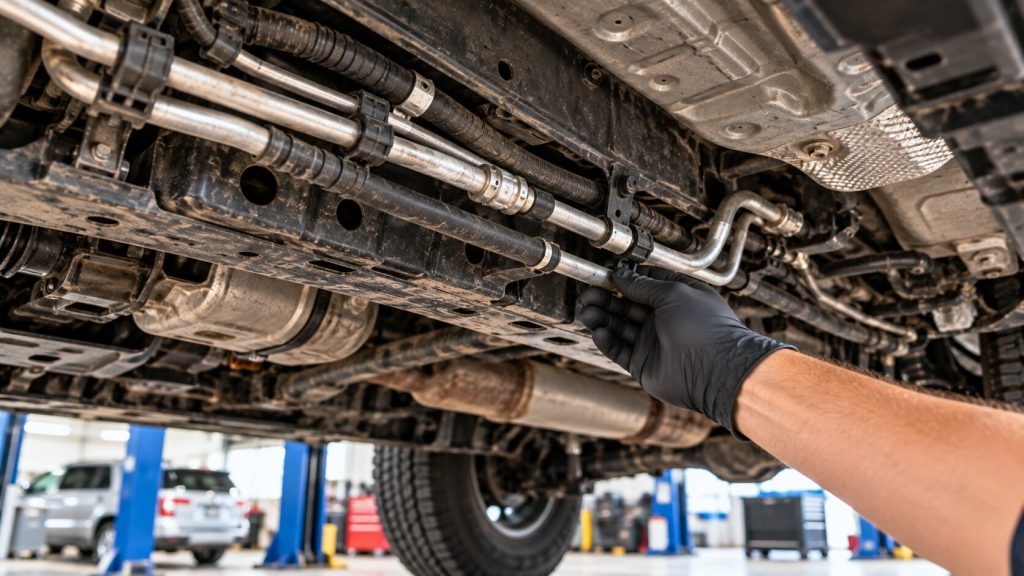
To feed that rear unit, refrigerant has to travel a long way. Lines run from the front of the vehicle, often along the underside, all the way to the back. That extra plumbing is what makes comfortable rear-seat cooling possible, and it is also what introduces a vulnerability a single-zone car never has.
The important point is that both evaporators draw from the same charge. A problem anywhere in that shared loop affects the whole system, which is why a failure that starts at the rear rarely stays a rear-only problem for long.
The Vulnerable Lines Running Beneath the Vehicle
Those long rear lines spend their life exposed. Tucked under the floor, they face everything the road throws upward, from gravel kicked by the tires to debris on a construction route to the occasional hard strike from an uneven surface. A larger vehicle with higher clearance is not immune, because the lines still sit in the path of what the tires fling up.
A single sharp strike rarely bursts a line outright. Instead it creates a tiny weak point, and over weeks that spot can develop a micro-leak so small it releases refrigerant a little at a time. This is the quiet distinction that trips up a lot of owners. The cooling does not fail suddenly, it fades, and a gradual fade is easy to blame on a hot week rather than a developing leak.
Because the loss is slow, the charge drops below the level the system needs long before anyone suspects a physical cause. By the time the air feels weak, the real event, a debris strike on an under-car line, may have happened a month earlier and miles away.
Why the Back Seat Feels It First
Here is the pattern we see most often with these systems. The front keeps blowing reasonably cold while the rear vents turn lukewarm, and parents notice because the kids in the back start complaining before anyone up front feels a thing. It seems like a rear-unit problem, but usually it is not.
When overall charge drops, the system prioritizes what it can, and the long run of line and the rear evaporator tend to show the shortfall first. So the rear going warm while the front still cools is often the earliest honest signal that the entire charge is low, not a sign that the rear evaporator itself has failed.
That difference matters for how the problem gets diagnosed. Treating it as a broken rear unit leads down the wrong path. Reading it as a system-wide charge loss points toward the actual cause, which is usually a leak somewhere along that exposed plumbing.
How We Separate a Leak From a Component Failure
When one of these vehicles comes in with weak rear cooling, we are careful not to jump to a conclusion from the symptom alone. Warm rear air is a clue, not a diagnosis. The job is to confirm whether the charge is low, and if it is, to find where it is escaping rather than simply topping it off and sending it back out.
A recharge without finding the leak is a temporary fix at best. The refrigerant that leaked out once will leak out again through the same weak point, and the cabin will be warm again by the next heat wave. Locating the actual micro-leak, often along an under-car line, is what turns a repeat problem into a solved one.
This is also where the shared-loop design works in our favor diagnostically. Once we know both cooling zones draw from one charge, a rear-first symptom becomes a useful map pointing us toward the long lines rather than the components behind the dash.
What Families Can Watch For Before It Gets Worse
The people best placed to catch this early are the ones riding in the back every day. Rear cooling that is not quite keeping up, a difference between front and rear comfort that was not there last summer, or cooling that weakens a little each week are all worth mentioning rather than tolerating.
Those observations genuinely speed up the work. When you can tell us the rear went warm first, or that the fade happened gradually over a few weeks, you have already pointed us toward a charge loss and away from the wrong suspect. A clear description of when and where the cooling dropped is often the most valuable thing you bring in with the vehicle.
If the back seat is trending warmer, it is worth a look before the full system falls behind. Our AC system repair work begins with those real-world patterns, then verifies charge and traces any leak to its source so the fix actually holds.
Schedule an Appointment to Keep Every Row Comfortable
If the rear of your SUV is not cooling the way it used to, an early check keeps the whole cabin comfortable and the vehicle dependable through the summer. Finding a small under-car leak now is far simpler than chasing warm air across an entire season of family drives. You can rely on John’s Auto Care to diagnose these complex issues accurately.
We are glad to inspect the full system and give you a clear answer on where the charge is going. Schedule an appointment with John’s Auto Care Center at (208) 974-5216, or stop by 499 S Meridian Rd, Meridian, ID 83642.
Frequently Asked Questions
Can a rear AC problem actually mean the whole system is low on refrigerant?
Yes. Because both evaporators share one charge, the rear often shows a system-wide shortfall first, even though the front still feels cold.
Is it worth just recharging the system to fix weak rear cooling?
Not on its own. A recharge without finding the leak usually cools for a while, then fades again once the refrigerant escapes through the same weak point.
Can road debris really damage AC lines on a tall SUV?
Yes. Higher clearance helps, but the under-car lines still sit in the path of gravel and debris thrown up by the tires, so strikes still happen.
Does warm rear air always mean the rear evaporator has failed?
No. More often it signals low overall charge, and the rear simply shows it first, so the rear unit itself is frequently fine.
How quickly does a micro-leak drain a system?
It varies, but these leaks are usually slow, releasing refrigerant over weeks, which is why the cooling fades gradually instead of stopping all at once.
