


Orifice tube clogging triggers total air conditioning failure when metallic shrapnel and carbonized oil contaminate the system. Extreme asphalt heat destroys air conditioning loops, forcing total component replacement to clear out microchannel debris and bring back reliable cabin cooling.
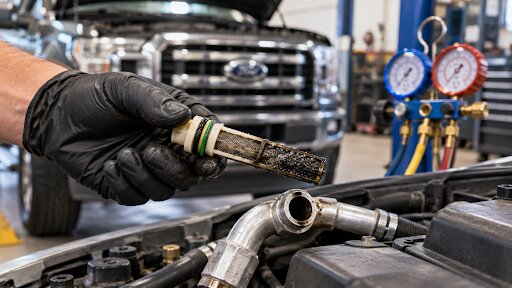
Orifice tube clogging on a 2018 Ford F-150 driving down Interstate 84 during a scorching Meridian July afternoon spells immediate thermal failure for the air conditioning compressor. When a truck comes into my shop with a completely dead climate control system, I know the refrigerant cycle has collapsed instantly because microscopic debris flooded the metering device and shut down cooling capacity entirely across the cabin.
Why North Texas Heat Destroys AC Compressors and Condensers
Normal operation relies on the brass-bodied orifice tube metering liquid refrigerant into the evaporator core via a precisely calibrated micro-aperture. But extreme Treasure Valley summer heat soaks the condenser, driving high-side pressures past 250 psi and pushing the compressor past its thermal limit. Internal swash plates and aluminum pistons begin to gall, shearing microscopic metallic shrapnel directly into the refrigerant stream.
This debris flows straight to the liquid line and jams behind the fine mesh screen of the orifice tube. This severe flow restriction starves the evaporator core and fries the compressor oil, turning oxidized lubricants and aluminum dust into an acidic sludge that wrecks the entire HVAC circuit.
A standard chemical flush cannot scour out carbonized debris wedged inside multi-pass microchannel condensers, meaning partial repairs are guaranteed failures.
Metallurgy and Friction Under Extreme Thermal Loads
When ambient temperatures climb past 100°F on local asphalt, the heat load placed on mobile air conditioning systems reaches critical thresholds. Refrigerant R-134a or R-1234yf operates under immense pressure, and when the condenser fails to dissipate heat efficiently, head pressures spike. This pressure spike places an extraordinary mechanical load on the compressor pistons, reed valves, and swash plates.
Aluminum-on-aluminum contact occurs when lubrication thins out under high temperatures. PAG oil loses its viscosity when thermally degraded, allowing metal components to scrape against each other without a protective hydrodynamic film. The resulting friction strips aluminum from the internal housing and pistons, generating fine metallic flakes that travel downstream with the liquid refrigerant.
Fluid Dynamics and Orifice Restriction
The orifice tube acts as a fixed restriction in the liquid line, dropping high-pressure liquid refrigerant down to a low-pressure liquid-vapor mix before it enters the evaporator core. Because the internal diameter of this tube is microscopic, any foreign particulate matter suspended in the refrigerant oil accumulates rapidly against the inlet screen.
As aluminum shards and carbonized PAG oil bridge across the mesh openings, mass flow rate drops drastically. The compressor continues to pull a vacuum on the suction side while starving for refrigerant on the discharge side, creating internal heat-soaking conditions that warp surrounding components. The pressure differential across the clogged orifice tube spikes, forcing the compressor to work harder while pumping less cooling medium through the system.
Advanced Diagnostics for Air Conditioning Contamination
Catching this failure before total compressor seizure requires a strict, methodical diagnostic protocol using high-end shop equipment.
- Pressure Measurement: Connect digital manifold gauges to monitor operating pressures on both the high and low sides. Low suction pressure combined with abnormally low discharge pressure points toward a severe restriction at the liquid line inlet.
- Temperature Differential Check: Measure the temperature across the liquid line directly before and after the orifice tube. A massive temperature drop or frost formation right at the tube body confirms a physical blockage restricting flow.
- Refrigerant Recovery & Oil Analysis: Discharge the system refrigerant into a certified recovery machine and inspect the captured oil sample under bright lighting for dark discoloration and suspended metallic flakes. Clean green or yellow oil turning pitch black with visible glitter indicates catastrophic internal wear.
- Orifice Tube Inspection: Extract the physical orifice tube using specialized extraction pliers to inspect the inlet screen for trapped aluminum debris. Finding metallic buildup on the screen mandates an immediate stop-work order regarding simple recharges or component band-aids.
- Vehicle Assessment: When pulling the liquid line on a 2018 F-150 after a run down the highway, finding metallic paste coating the orifice inlet screen means the swash plate has already failed internally.
Comprehensive System Restoration Procedures
Restoring thermal efficiency to a contaminated climate control loop demands a complete teardown and replacement strategy rather than a simple part swap.
Flushing Protocols and Limitations
Technicians often debate the viability of flushing contaminated lines, but standard solvent flushes fail against heavy carbon deposits and multi-layer parallel condensers. Modern microchannel condensers feature tiny serpentine passages that trap metallic shrapnel permanently within their aluminum matrix. Flushing these lines merely dislodges debris for a short time, leaving hidden shrapnel free to circulate and wreck a replacement compressor shortly down the road.
Component Replacement Matrix
To permanently eliminate black death contamination, several critical components must be replaced simultaneously as a complete assembly group.
- Compressor: The primary source of metallic debris must be swapped out for a new or remanufactured unit equipped with fresh PAG oil matching factory volume specifications.
- Condenser: Parallel-flow condensers cannot be cleaned effectively and require immediate replacement to prevent latent shrapnel from escaping into the new lines.
- Accumulator or Drier: This desiccant bag traps moisture and particulate matter, and once saturated with acidic black oil, it must be discarded.
- Orifice Tube: Always install a fresh calibrated metering device to ensure correct pressure drop across the evaporator inlet.
- Flushing Lines: Aluminum barrier hoses can be flushed using specialized fast-evaporating solvent and dry shop air, provided no internal muffler traps debris.
Securing Your Air Conditioning System
If you keep running the AC once the compressor starts shredding, that debris circulates through the entire loop and wipes out your brand-new parts before you even hit the highway. Skip the two-week dealership wait and bring your truck straight to John’s Auto Care Center at 499 S Meridian Rd, Meridian, ID 83642, for a proper teardown and total system restoration with our auto repair team.
Frequently Asked Questions
Can a simple refrigerant recharge fix a clogged orifice tube?
No, adding fresh refrigerant or sealants will not clear physical metallic debris or reverse black death contamination trapped inside the system components.
Is it possible to flush out metallic shrapnel from every part?
No, modern parallel flow condensers and mufflers trap aluminum particulate in tiny passages, leaving full component replacement as the only real fix.
Will driving with a failed compressor damage other engine accessories?
No, the air conditioning compressor operates on its own dedicated serpentine belt circuit and clutch pulley independent of core engine functions.
Do high local summer temperatures directly cause this mechanical failure?
Yes, intense ambient heat elevates system pressures and drives aging compressors past their thermal breakdown point, resulting in internal metal shredding.
