Proper GDI engine thermal management depends on recognizing how traffic jams trigger severe heat in the engine bay and high AC demands. This combination triggers high-pressure fuel rail vapor locking, carbon-fouled injector tips, and idle hesitation. Advanced diagnostics require monitoring live multi-sensor data waveforms to catch thermal failures before permanent engine damage occurs.
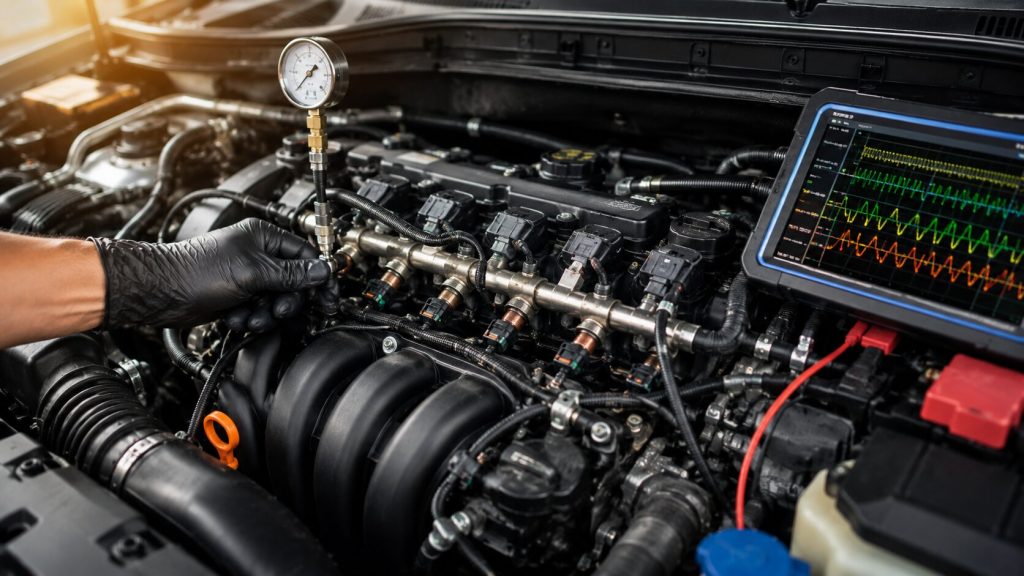
During stop-and-go gridlock on Chinden Boulevard in Meridian, I frequently see direct-injection engines suffer from localized injector tip coking as engine bay temperatures spike under heavy electronic air conditioning loads. The primary engine control module constantly recalculates thermal saturation maps to prevent fuel rail flash boiling while cycling the variable displacement compressor.
Thermal Physics and Fuel Rail Cavitation
Direct gasoline injection operates under extreme pressure, often exceeding 2,000 psi, with injectors positioned directly inside the combustion chamber. While rushing ambient air cools the cylinder head during highway driving, idling in heavy traffic causes airflow to drop to zero, allowing radiant heat from the exhaust manifold to transfer into the intake valley.
In these gridlock conditions, the high-pressure fuel rail experiences extreme heat-soaking, causing the liquid fuel to absorb excessive thermal energy. Instead of forming a fine, atomized mist, the fuel undergoes localized vapor-locking or flash-boiling inside the rail. The engine control module responds by altering injection timing and commanding aggressive cooling fan duty cycles, but physical thermal saturation causes the injector tips to become carbon-fouled and pitted. In short, when the engine gets too hot, the fuel doesn’t spray properly, which damages the injectors over time.
Diagnostic Verdict: If your high-pressure rail data drops below 1,800 psi during a hot idle on Chinden, the mechanical plunger is cavitating—don’t just throw a sensor at it.
Proactive Diagnostic Process for Thermal Management
When I catch thermal management failures before they trigger catastrophic lean misfires, I rely on moving past generic diagnostic trouble codes and analyzing live multi-sensor data streams. I use advanced diagnostic scanners and multi-channel lab scopes to monitor how the powertrain computer handles extreme heat events.
Diagnostic Testing Sequence
- Connect an advanced scan tool and a multi-channel lab scope to capture high-resolution waveforms of the fuel rail pressure sensor and the air conditioning compressor control valve concurrently.
- Monitor live data for high-pressure fuel rail fluctuations while running a prolonged idle test that simulates real-world traffic conditions.
- Check the voltage drop across the displacement control solenoid to see if electrical resistance rises as engine bay temperatures climb.
- Test the low-pressure fuel supply with an inline gauge to confirm the in-tank pump delivers adequate volume when thermal expansion thins the fuel.
- Examine the physical injector spray patterns on a bench test rig if witness marks indicate thermal coking or tip distortion.
Powertrain Software and Thermal Load Balancing
Engine management computers use complex algorithms to balance parasitic accessory loads against thermal limits. As the AC compressor engages under strain, the engine control module (ECM) actively manages parasitic power reduction strategies by cycling the compressor control valve to prevent abrupt engine speed dips. However, when combined with high fuel rail temperatures, the computer must constantly adjust the injection pulse width. If the fuel temperature rises too high, the density of the gasoline changes, which alters the mass of fuel entering the cylinder. The engine computer adjusts by lengthening the injection time, but extreme heat still makes proper fuel ignition a major challenge.
Mitigating Heat Soak in Direct Injection Systems
Preventing long-term damage from thermal saturation requires regular maintenance of both the cooling system and the fuel delivery architecture. In my shop, I often check for degraded insulation around the high-pressure fuel lines and verify that the engine cooling fans operate at maximum multi-speed capacities. Keeping the radiator fins and cooling passages clean drops engine bay temperatures during congested urban commutes.
Commercial Maintenance Services
Wait too long to fix it, and a simple heat soak turns into a failed pump, scorched injector tips, and an unexpected tow bill. Standard software updates usually don’t fix the heat-related problems caused by our local driving conditions. If your direct-injection setup is stumbling every time the cooling fan kicks into high gear, swing by John’s Auto Care Center at 499 S Meridian Rd, Meridian, ID 83642. We’ll hook up the lab scope and sort your thermal soak issues out.
Frequently Asked Questions
Can a failing AC compressor cause a direct injection engine to misfire?
Yes. The massive parasitic drag from a failing compressor alters engine speed instantly, forcing the computer to recalibrate fuel delivery while the rail is already suffering from thermal soak.
Will clearing fault codes fix a hot-soak hesitation issue?
No. Diagnostic trouble codes only report the symptom, whereas thermal coking and vapor-locking require physical component testing and live data monitoring to resolve.
Is high-pressure fuel pump wear accelerated by ambient summer heat?
Yes. High heat makes gasoline thinner and less dense, stripping away its natural lubricating properties and wearing out high-pressure pump parts faster.
Does stop-and-go traffic degrade engine cooling efficiency over time?
Yes. Sitting in traffic too long traps radiant heat under the hood, throwing off sensor accuracy and pushing cooling systems past their limits.